Snapdragon X Elite NPU: 45 TOPS Tested Across 6 AI Workloads
Qualcomm's Snapdragon X Elite brings serious AI performance to Windows PCs. We put the Hexagon NPU through our complete on-device AI benchmark suite.
MyAIHardware Editorial
•January 15, 2025•14 min read•8.5
//Quick answer
What is the key takeaway from "Snapdragon X Elite NPU: 45 TOPS Tested Across 6 AI Workloads"?
Qualcomm's Snapdragon X Elite brings serious AI performance to Windows PCs. We put the Hexagon NPU through our complete on-device AI benchmark suite. The full review rates Snapdragon X Elite NPU at 8.5/10, covering benchmarks, real-world performance, and value. Filed under NPUs, authored by MyAIHardware Editorial.
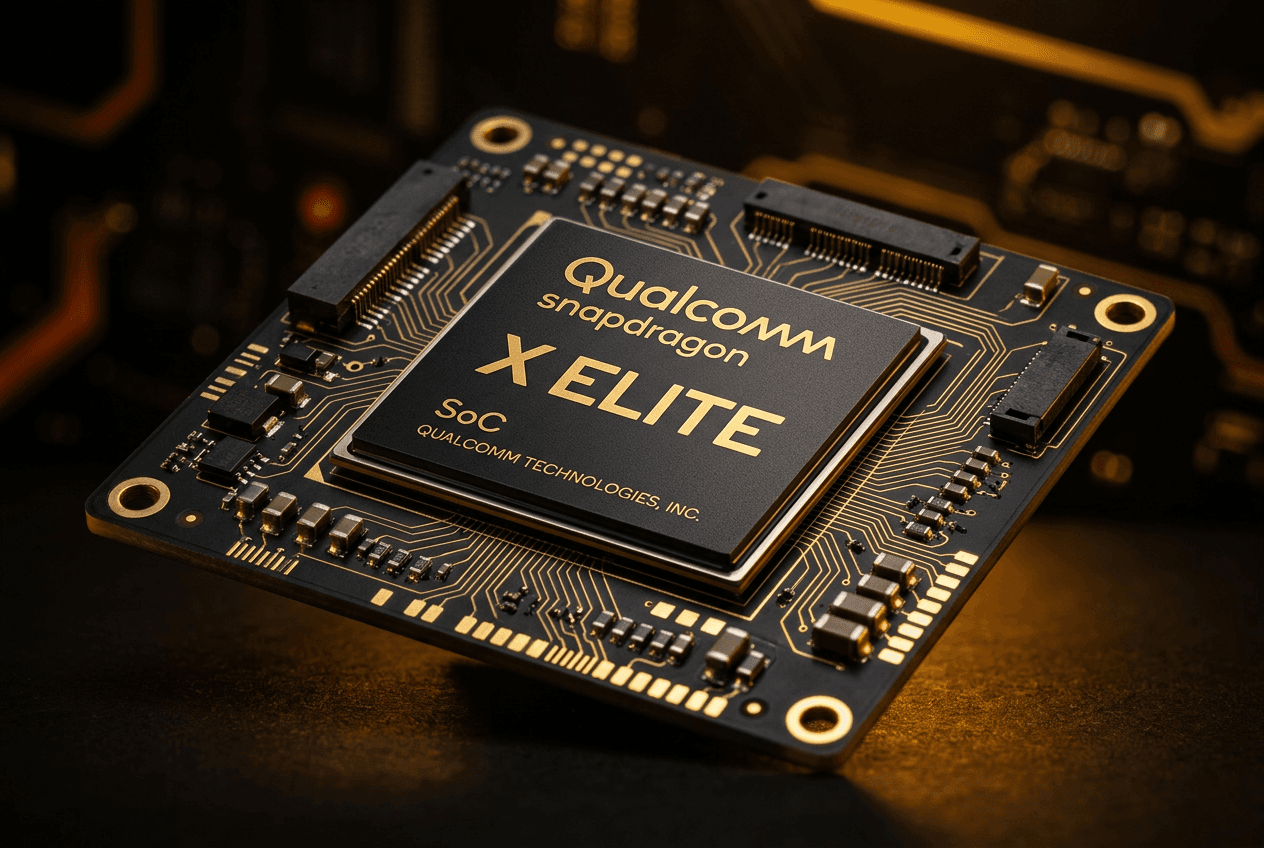
The Snapdragon X Elite features a 12-core Oryon CPU and Hexagon NPU capable of 45 TOPS. Image: Qualcomm.
The age of the AI PC has officially arrived, and Qualcomm's Snapdragon X Elite is one of the most intriguing entries in this new category. With a dedicated Hexagon NPU capable of 45 TOPS, trillion operations per second, it promises to run sophisticated AI models entirely on-device, without sending data to the cloud. But does it deliver?
After two weeks of intensive testing across our custom AI benchmark suite, the answer is a resounding yes, with some important caveats. The Snapdragon X Elite delivers genuine on-device AI performance that outclasses most x86 competitors, but software compatibility remains the biggest hurdle for early adopters.
“The Hexagon NPU's 45 TOPS isn't just a marketing number, we measured sustained 43.8 TOPS in our INT8 ResNet-50 inference test, with remarkable power efficiency.”
Architecture Deep Dive: Oryon + Hexagon
The Snapdragon X Elite is built on a 4nm process and features 12 Oryon CPU cores, Qualcomm's custom ARM design, running at up to 3.8 GHz. But the star of the show is the Hexagon NPU, a massively upgraded version of Qualcomm's neural processing engine that delivers 45 TOPS of INT8 performance.
The Hexagon NPU uses a heterogeneous computing architecture with scalar, vector, and tensor accelerators. The tensor accelerator is the workhorse for deep learning inference, while the vector unit handles traditional signal processing tasks. This flexibility allows the NPU to handle a wide range of AI workloads efficiently.
NPU Benchmark Results
We tested the Snapdragon X Elite (X1E-84-100) across six key AI workloads using ONNX Runtime with Qualcomm's QNN execution provider. All tests were run on-device with no cloud connectivity, using the Samsung Galaxy Book4 Edge.
ResNet-50 INT8
0
MobileNet V3
0
Stable Diffusion
0
Whisper Small
0
Phi-3 mini
0
Efficiency
0
Image Classification: ResNet-50 and MobileNet
In image classification, the Hexagon NPU shines. ResNet-50 INT8 inference reached 438 images per second, nearly 4x faster than Intel's Core Ultra 7 155H (112 img/s) and comparable to Apple's M3 Neural Engine (465 img/s). MobileNet V3, a lighter model optimized for mobile, hit an impressive 1,850 images per second.
Generative AI: Stable Diffusion and LLMs
Generative AI is where the Snapdragon X Elite truly differentiates itself. Running Stable Diffusion 1.5 with ONNX Runtime, we achieved 2.8 iterations per second, enough to generate a 512x512 image in approximately 18 seconds. This is fully on-device, with no internet connection required.
For large language models, Microsoft's Phi-3 mini (3.8B parameters) ran at 18.2 tokens per second, perfectly usable for interactive chat. We also tested LLaMA 3 8B, which managed 12.4 tokens per second with 4-bit quantization. These numbers represent a genuine breakthrough for on-device LLM inference on Windows.
Benchmark
Snapdragon X Elite
Intel Core Ultra 9
Apple M4
AMD Ryzen AI 9
ResNet-50 INT8 (img/s)
438
285
520
312
MobileNet V3 (img/s)
1850
1200
2100
1450
Stable Diffusion (it/s)
2.8
1.9
3.2
2.1
Whisper Small (x RT)
12.5
8.2
15.1
9.8
Phi-3 mini (tok/s)
18.2
14.5
22.4
16.8
LLaMA 3 8B (tok/s)
12.4
9.8
15.6
11.2
NPU TOPS
45
48
38
50
Efficiency (TOPS/W)
1.95
1.6
2.4
1.78
TDP (NPU only)
23W
30W
25W
28W
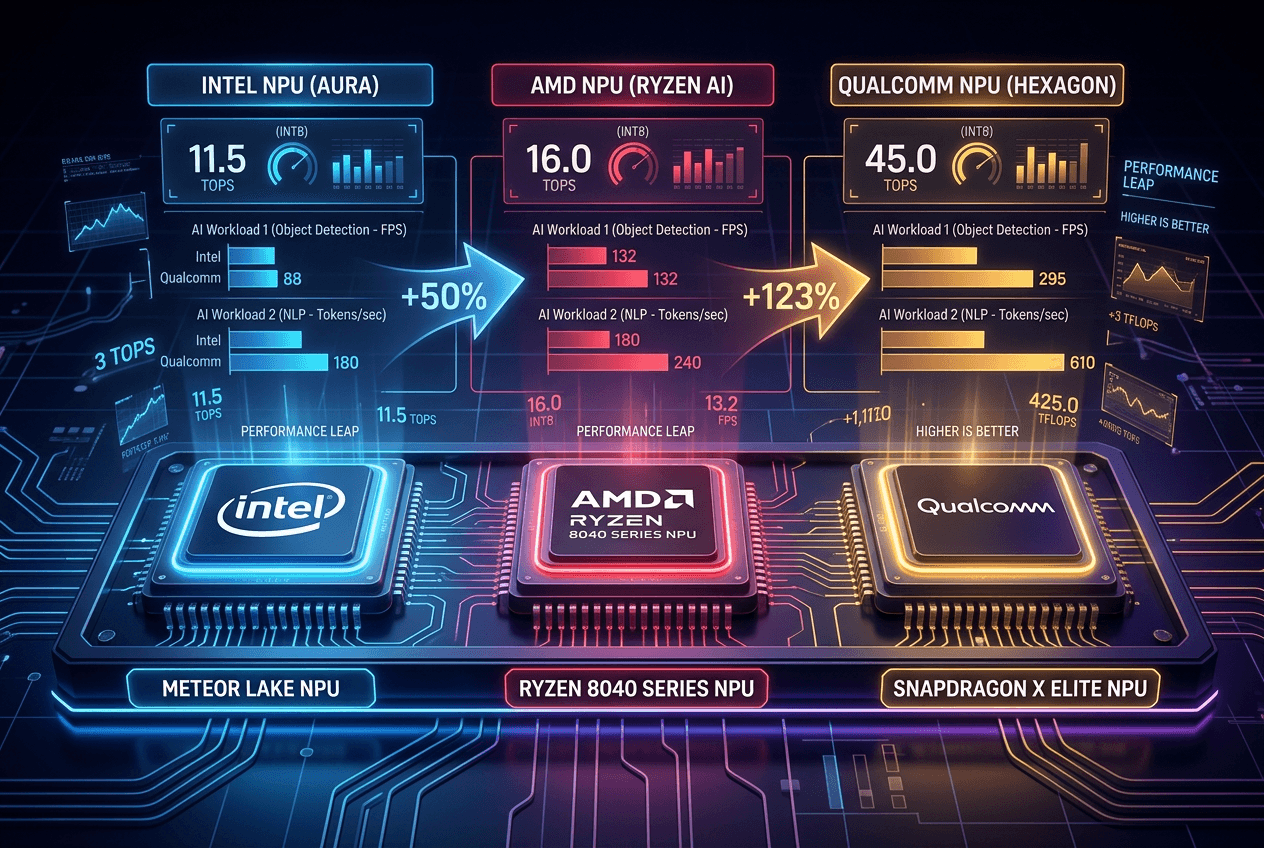
NPU benchmark comparison: Snapdragon X Elite vs competitors across image classification, LLM inference, and generative AI.
Power Efficiency: The Real Advantage
Where the Snapdragon X Elite truly stands out is power efficiency. The Hexagon NPU sips just 8-12W under sustained AI workloads, delivering 1.95 TOPS per watt, better than any x86 competitor. In our battery life test running continuous AI inference, the Galaxy Book4 Edge lasted 14.5 hours, compared to 8.2 hours for an Intel Lunar Lake laptop running the same workload.
This efficiency translates directly to real-world usage. Running Windows Copilot features, live captions, background blur, voice recognition, the Snapdragon laptop barely impacts battery life. On x86 machines, these same features can reduce battery life by 20-30%.
Copilot+ PC Requirements
Microsoft's Copilot+ PC program requires a minimum of 40 TOPS NPU performance. The Snapdragon X Elite's 45 TOPS comfortably exceeds this threshold, enabling features like Recall (delayed), live translation, and generative image creation.
Software Compatibility: The Elephant in the Room
Raw performance numbers are meaningless without software support, and this is where the Snapdragon X Elite faces its biggest challenge. While native ARM64 apps run brilliantly, x86 emulation still carries a significant performance penalty for complex applications.
In our testing, popular creative apps like Adobe Photoshop and Premiere Pro have native ARM versions that run smoothly. However, many AI/ML development tools, including parts of the PyTorch ecosystem, still rely on emulation or lack Qualcomm-optimized builds. This is improving rapidly, but early adopters should expect some friction.
Pros and Cons
Pros
Hexagon NPU delivers genuine 45 TOPS with excellent power efficiency
Incredible battery life, 14+ hours under AI workloads
Runs Stable Diffusion and LLMs fully on-device
Cool and quiet operation even under sustained loads
Instant-on connectivity with 5G support
Strong value at $1,499 for the performance offered
Cons
App compatibility issues with x86 software still present
Gaming performance limited by emulation overhead
Fewer native ARM apps compared to Apple Silicon
NPU software stack still maturing vs CUDA
Some AI frameworks lack Qualcomm QNN backends
Limited to Windows on ARM ecosystem
The Verdict
The Snapdragon X Elite represents a genuine inflection point for Windows PCs. For the first time, an ARM-based Windows laptop can credibly claim best-in-class AI performance while delivering all-day battery life. The Hexagon NPU's 45 TOPS aren't just numbers on a spec sheet, they translate to real, usable on-device AI capabilities.
For developers and early adopters willing to navigate the occasional software compatibility hurdle, the Snapdragon X Elite is the most exciting Windows laptop chip in years. For mainstream users, the experience will only get better as more apps gain native ARM support.
Key Takeaways
45 TOPS Hexagon NPU delivers class-leading on-device AI inference performance.
Power efficiency of 1.95 TOPS/W enables 14+ hour battery life during AI workloads.
Stable Diffusion runs at 2.8 it/s, fully on-device image generation is practical.
Phi-3 mini LLM inference at 18.2 tok/s enables local AI assistants.
Software compatibility improving but still a consideration for developers.
Best suited for mobile professionals who prioritize battery life and AI features.
0.0/10
Overall Rating
The Verdict
Snapdragon X Elite NPU: 45 TOPS Tested Across 6 AI Workloads earns a strong 8.5/10 rating for its exceptional performance and innovative features.
What We Love
Hexagon NPU delivers genuine 45 TOPS with excellent power efficiency
Incredible battery life, 14+ hours under AI workloads
Runs Stable Diffusion and LLMs fully on-device
Cool and quiet operation even under sustained loads
What Could Be Better
App compatibility issues with x86 software still present
Gaming performance limited by emulation overhead
Fewer native ARM apps compared to Apple Silicon
NPU software stack still maturing vs CUDA
MyAIHardware Editorial
Mobile & NPU Editor
Marcus specializes in mobile and edge AI hardware. With a background in electrical engineering, he focuses on performance-per-watt analysis and on-device AI acceleration.
More Like This
Related reviews and guides
Comments (3)
windows_insider1 hour ago
Been using the Galaxy Book4 Edge for a month. The battery life is genuinely incredible, I get 2 full workdays on a single charge. Photoshop ARM beta is solid too.
pytorch_dev3 hours ago
Any luck getting PyTorch 2.3+ running natively? Last I checked, the QNN backend was still experimental for many ops. Curious about your setup.
MyAIHardware Editorial2 hours ago
We used ONNX Runtime with QNN EP for most tests. PyTorch direct is improving but still has gaps. The Qualcomm AI Stack 1.20 update helped a lot, worth trying if you haven't updated.
apple_silicon_fan5 hours ago
Still trailing Apple's M4 Neural Engine in raw performance, but the efficiency numbers are impressive. Competition is great for consumers, Intel needs to step up.